The key fidget: clicking without a keyboard
A good key can do something a touchscreen cannot: it answers back. You press, feel it travel down, hear the click and let go. Afterwards nothing has been written and nothing has been sent. That is the whole idea of our key fidget: a mechanical keyboard that gives up everything except the pressing.
Real hardware, not a lookalike
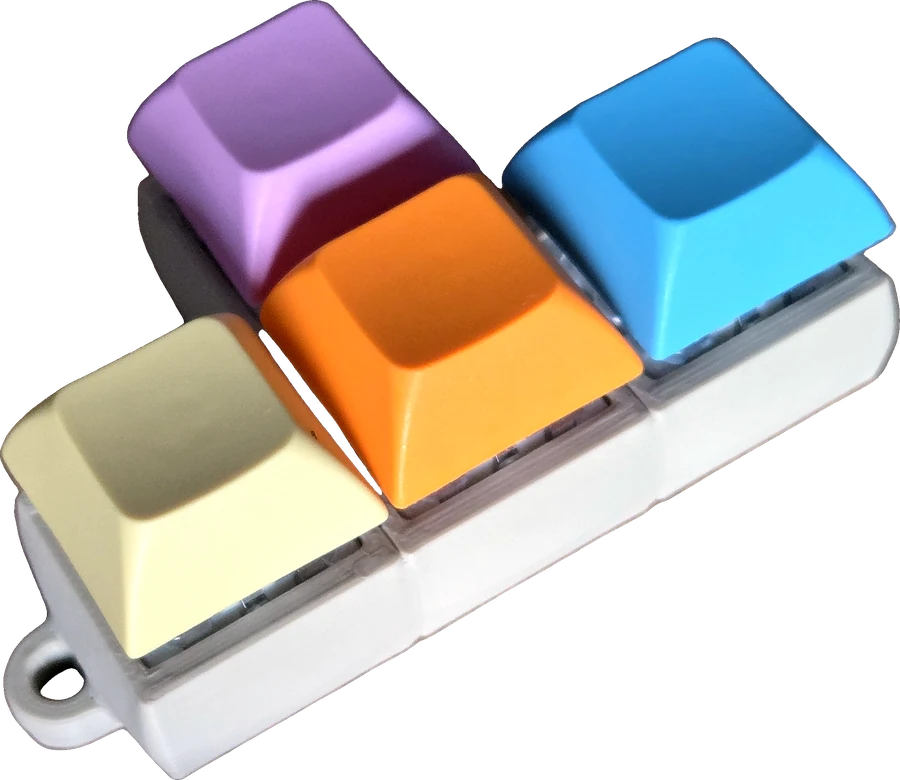
Under every cap sits a real mechanical keyboard switch. There is no cable, no battery and no software. The build is simple: one printed part with an eyelet for your keyring, plus one switch and one cap per key. The caps are PBT, blank and in DSA profile: low, with a round dish for your fingertip, and the same height on every key. With no legend to distract you, all that is left of the key is what matters here: its shape, its colour and the moment it gives way.
Nothing gets typed here. It only gets pressed.
Eight layouts, and your fingers already know two of them
The single key is the smallest form and fits on a keyring. The 9-key block is more of a desk object, since it has room for several fingers at once. In between are two to four keys in a row and a block of six.
And then there are WASD and the arrow keys, familiar to anyone who plays on a computer. On WASD the W sits 12.6 millimetres to the right of the A and above it, as on a real keyboard, and the arrow keys form the familiar inverted T. Your fingers should find their place without you looking. The fidget does not control a game, but it gives your fingers something to do during a loading screen or in a queue. No input lag. No input either.
Every cap is its own decision
Every key can have one of 16 cap colours, three of them clear or translucent. A red W and the rest in black? In the configurator you see your fidget as a 3D model while you put it together. You can give all keys the same colour, pick each one yourself or leave it to chance. We then assemble it by hand to your choice.
One more note: the key fidget contains small parts and is therefore not suitable for children under 3.